It's Monday morning, and I'm barely on time for my first class. I blow into Room 120. Coffee in one hand, laptop half out of my bike bag, ungraded papers and Tupperware spilling onto the desk, basically falling apart.
I've got nothing—no lesson plan, no notes, no worksheets—nothing. But a quick glance out at the kids confirms that it will be fine. These are my 11th graders, a gregarious bunch of know-it-alls who like nothing more than pulling me off-topic—past triumphs, mishaps, random crap—anything but what we're supposed to learn. They're in no hurry for class to start. They'll toss me ten minutes to get my act together, messing around while I sketch some notes, send a doc to the printer, dash off a reflection question for them to B.S. for five minutes—or ten—pick up copies, come back, hand them out, and then it's GO time.
But for whatever reason, today is different. The bell rings at eight and—bang. My cheerfully defiant students, moments before jawing and joking, attempting TikToks and finessing their hair, drop into a sudden silence.
Inexplicably, they're model students, staring up at me expectantly.
All year, I've campaigned for this silence, and here's my class, handing it to me precisely when I need it least. Perhaps they sense it. This Monday morning, Mr. Coady, the teacher who sermonizes on the moral failings of arriving unprepared, has shown up with nothing.
Coady doesn't know what he's doing!
Watch him bomb!
I spin toward the board, a tauntingly empty expanse of glossy white. My world map hangs half-lowered; at the top, Spain is separated from Morocco. And that's when it hits me: Gibraltar. The Rock. I reach back to something somebody said in grad school, or a think piece in some long-shuttered magazine, or God knows what. It might be enough to get me out of this jam.
"Doors," I say, more to myself than the kids. A moment passes.
I turn back to the class and repeat, "Doors."
They stare at me blankly.
I tap the map behind me: "Doors…"
A helpful but confused student in the back gets up and heads toward the classroom door. I wave them back to their chair.
"Not door," I say. "Doors…"
Natalie, a regular tormentor, gives me a long look from the front row. She's our class cynic, heavy on the goth eyeliner and the tart aside.
"Yeah, doors, Coady," she says. She turns back to the rest of the class. "Doors… Hey, look, everybody, doors…" She gets a slight chuckle, but the rest are too confused to play along.
I reach back, tap the map again.
"Doors. This is one of them."
"Sorry, Coady," says Natalie. She waits. "That's a wall."
"No." My finger flies four thousand miles east, lands on the Himalayas. "This is a wall." I drag my finger back to Gibraltar. "This is a door."
Natalie shrugs. "Okay, Coady. Whatever. It's a door."
"No, seriously," I say. "Why is it a door?"
Caleb, in the front row, stocky, unhurried. He nods at the map and says, "Because you've got two sides, like a door. Africa, Europe."
"Good," I say. "And what can you do with a door?"
Caleb shrugs. "Walk through them?"
"Yup, walk through them. What else? Anybody?"
Asher, thin limbs and a revolving wardrobe of t-shirts, stirs in the back.
"Open them," he says.
"Yes, open them. And…?"
Arty Marie, sitting next to Asher: "Close them."
"Yes. Close them. Okay, now we've got it."
Let’s go. Take out your laptops and get in groups of three or four. Go to Google Maps. Identify some doors—take two and analyze how they impact the countries around them. You’ve got fifteen minutes.
Soon enough, the kids identify important chokepoints—that's what tacticians call these doors—and they're ready to share, hands up. We take a little trip around the world. Straits of Messina: They give Italy control of the central Mediterranean. Bab-el-Mandeb: That's where those Houthi pirates cause problems. Straits of Malacca: treacherous, geopolitically hot.
We move to Istanbul.
A crooked sliver of water, a chokepoint.
And this? It's the best piece of real estate in the history of the world.
Caleb challenges me: Why?
Because it's the Turkish Straits, the chokiest point of them all. I move my finger to the bottom strait: look here, the Dardanelles, the door to the Aegean Sea. You can't see it on this map, but if we were on Google Maps and hit the terrain button, you'd see hills here. You know what I've always told you about hills: Easy to defend. Want to win a battle? Get the high ground, especially if your opponent comes in on water, sopping wet. Gallipoli is that high ground.
I move my finger a few centimeters up the map: Look a bit further up the straits, we've got this great hidden bay. Park a fleet there to shred an enemy flotilla coming our way. Farther up, the strait narrows to 750 yards. Fishing boats can block our opponent here. If they survive these—unlikely—our enemies will hit the wide-open Sea of Marmara and experience brief relief. But guess what? On the other side sits modern-day Istanbul. Now our enemies are facing the strangulation of the Bosphorus, the top strait, which is consistently narrow and gets as thin as 900 yards. That's slingshot-defensible. This isn't just a couple of straits, folks. It's a hallway in a haunted house filled with trapdoors, nooses, and spikes. It’s also the longest-running, highest-rated drama in history.
I put the question back to Caleb.
Why is this the most important piece of land in history?
"I don't know," he says, "because you can control it?"
Right. But what do we control?
"Boats?"
Yeah, boats. Or ships. And what goes on ships?
Caleb looks at me like I'm nuts.
I put it to the class: What goes on ships, guys?
Silence. They don't get it. When they think of ships, they think of yachts, and we all know what goes on yachts: rappers and billionaires. They're aware of something called a navy but are not sure what they do. Fight wars, they guess. But it's been forever since there was a real war on the high seas. They figure that the U.S. spends $250 billion annually to give Tom Cruise a place to land in a blockbuster film—good PR to justify all that money spent.
Meanwhile, my students are clad in an array of foreign textiles. They are driven to school in German and Japanese automobiles. Chinese-made phones sit chirping in their pockets. And still, they have no clue.
Everything. Everything goes on ships. Everything in this room. Most everything at your house. It all came in on a ship.
They likely figure, as I would have at that age, that it all comes from the back of a truck—or, if they're out to lunch, from the belly of a plane. But the back of a truck is the last part of a long journey, and the belly of a plane is an expensive way to ship lawnmowers and plates. Next time you're at Walmart, look around: You're walking through a container ship that's been coughed into a box store. Too bad they can't dock the cargo ship in the parking lot.
This door, I say, my finger back on the Turkish Straits—it’s the most pivotal door of the First World War. When it closed, it brought Russia to its knees. Everything in history would be different if it had stayed open. But it didn't.
My finger wanders west across the map, back to Gibraltar and the thin strip of water that separates Europe from Africa.
Door number two…
What's behind door number two?
An epic siege here helped invent the United States of America. Later, during the Second World War, the head of Nazi military intelligence was actually an anti-Nazi who loved tapas and sunny beaches and Spanish ladies and British tact—and because of this, Hitler missed his chance to rule the Mediterranean and wound up losing the war in a city named for his archnemesis.
The class likes this: Tapas and Nazis.
“What’s tapas?” they want to know.
Overpriced little plates of food. Something you get in a bar.
They think they would like tapas, especially if they could drink a beer with it. They want me to explain Gibraltar now. Tell us more, Coady, they say in unison, keeping me off topic. It’s easy to get Coady to squander precious classroom time getting sidetracked into grand narratives and random facts.
This time, I resist. No, I say, it's complicated. You'd have to understand Hegelian dialectic, rival ideologies, appeasement, and iron ore deposits. They say this is exactly what they want to hear about: Tapas and Nazis.
Not yet, I tell them. Maybe later.
My finger sails east, covering a passage so thin it's invisible on the map.
Door number three…
Welcome to the Suez Canal, geopolitical superstar of the 20th century. Punk rock was invented because the Suez Canal closed in 1967.
Stay with me: An Egyptian president's attempt to reopen it by force, a delayed flight of U.S. aid, strong headwinds over the Azores, an oil embargo, stagflation—and there you have it: Sid Vicious, Joey Ramone, flickering fluorescent lights, and peeling linoleum. The students like that one: Sure thing, Coady, Sid Vicious and the Suez Canal… good one… You're funny…
Keep talking… Save us from the real work.
Whatever I tell them, they'll laugh.
"What about New York?" says Asher. "That's kind of like a door, isn't it?"
Good question. There’s a bunch of chokepoints there.
I put it to the class: What do you think? Is New York a door?
"Nah," says Caleb. "Not enough behind it."
"Yeah," says Natalie. "It's a closet door."
They are right, at least in modern times, though I am tempted to throw the Battle of Brooklyn on the fire: Do you know that the British, aided by Hessian mercenaries, marched through Brooklyn farmland to capture the Port of New York? Because it led to the Hudson beyond. Because capturing that river might have split the colonies in two and tamed the rebellion.
What about the Erie Canal?
Want to learn how a lock canal works? Did you know the Erie Canal made New York into the biggest city in the United States instead of, say, New Orleans?
But we're out of time. The bell rings.
Students gather their things. They’ve kept me off-topic and are satisfied customers. They can go home and smugly inform their parents that everything in the house came from a ship—a fact these parents will be overjoyed to hear, especially coming from smart-ass teenagers who they buy all this crap for.
Only one small problem exists: this is an Advanced Placement (AP) U.S. History class. None of what I've taught will be on the all-important exam at the end of the year. Each class counts, and here I have blown sixty minutes on faraway straits.
I make a solemn vow: Never again.
No more blocks burned talking about straits. We'll stay focused, absorb facts, and make it through the Reagan administration.
Then the next class enters, and I immediately break my vow, repeating the same lesson, embellishing more. And I break my vow with the class after that. By late afternoon, I play the Ramones, show clips of the Yom Kippur War, and photos of gas lines in the '70s. Do you know that the closure of the Suez Canal led to stagflation, Johnny Rotten, empty parking lots, and punk rock?
Sure thing, Coady, you're funny, stagflation and the Suez Canal… good one… keep talking, Coady. Sail us as far off topic as you like…
They think I'm making things up.
But most of it is true or can at least be argued: The tapas and the Nazi turncoat—mom jokes over the sand berms—crosswinds that lead to an oil embargo that gives birth to punk rock—it's all true. Kind of.
Something being funny and far-fetched, even damn near unbelievable, does not mean it's a joke. After all, God has a wicked sense of humor.
Read on. Find out for yourself.
I leave school acutely aware of the geography around me.
A big crowd forms at the front door, and I imagine how bad it would be if a fire broke out. It’s a chokepoint. Then I get on my bike and climb the hill to my house. This morning, it was so easy to glide down. Now I’m exerting myself and thinking about how unfortunate it would be if I were riding up into enemy fire. And look over there, the bike path. It's an old railroad track that once connected this part of the world with the big fish in Boston. They had access to the ocean and controlled trade while we sat inland doing all the hard labor in the valley.
By the time I get home, I'm almost overwhelmed by the terrain in my little town. Scale it up and the whole thing becomes a cosmic joke.
Think of it: two massive land masses running north to south—the Americas, and Europe and Africa—and there’s not one natural passage across.
Not one. Anywhere.
Imagine that the goal of an entire age is to sail west from Europe to get to the goods of China, and there lies, in between, a massive north-south land mass—one that grows thin in parts, tantalizingly thin, and yet never breaks. No passage through exists. And believe me, they tried—Columbus and Hudson, Vancouver and McClure, who made progress only when he jumped ship and hopped onto a dog sled. That means you have to sail an extra sixteen thousand miles and deal with some of the worst weather on planet Earth.
Moving east from Europe wasn't much better. Islamic control of land routes led to prohibitively high taxes. So, Europe scrambled around Africa—another sixteen thousand miles, another five months, more terrible weather.
In both cases, a shortcut would change everything.
Now, those shortcuts exist: the Panama and Suez canals. Along with the natural straits provided by Mother Nature, these are nautical chokepoints. Because the land is close enough on both sides, these narrow passages of water can be controlled by cannon, by mines, by ships, even by rifles in a pinch. Capture these doors, control them, and you'll make history by the bushel.
And this is my claim: The terrain calls the shots.
Our stage was set hundreds of millions of years ago. We’re just the most recent cast. Nothing we can do will change what is beneath our feet, and nothing we can do will allow us to elude its cold calculus.
Case in point: Three well-stocked Empires got lost in the mountains of Afghanistan—beaten by soldiers on mules, homemade weapons in their satchels. They were able to hide in the crevices. Soviet Mil Mi-24s and American UH-60 Black Hawks hovered, burning fuel and firing expensive rockets that slammed into rock faces. All that technology, all that funding, all those decisions made by all those powerful people, and the terrain won anyway.
In 1588, Philip II sent his Spanish Armada to England with the Pope's blessing. He had God on his side—and 130 ships, 8,000 sailors, and 19,000 soldiers. English forces were about half that size, making this an easy pick for the Spanish. Philip II—and apparently God—forgot just one key factor: the English Channel. Prevailing winds, narrow straits, Atlantic storms—nature and the terrain turned the greatest naval force ever assembled into toothpicks. Philip later said he sent his ships to fight the English, not the waves.
So much popular history is driven by personalities. We lavish superlatives on world-historical heavies. It’s good fodder for movies. But I'm skeptical that one person, or even a group of them, directs the course of world events. Peel the personality layer back, and you find economics. Peel the money back, and you find the weather, or the position of the sun, or the tide. Underneath all of it—underneath everything—is the world itself, the terrain beneath our feet.
We cannot escape it. No technology eradicates a mountain range, not even a thousand hydrogen bombs. No navy un-narrows a strait.
The board is set. We play the game it dictates.
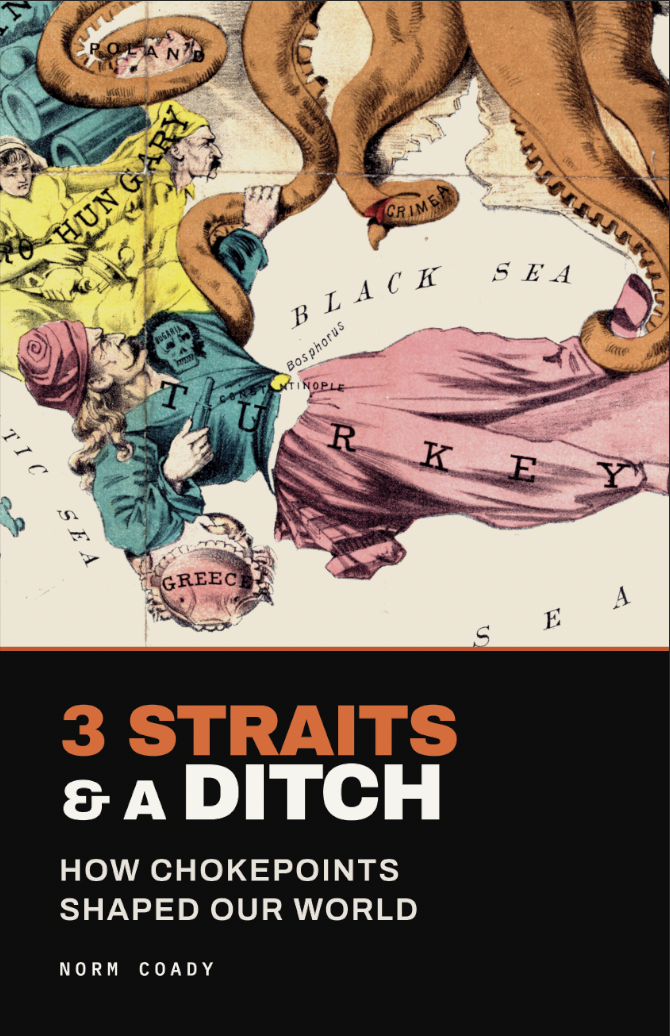
This book focuses on four chokepoints: The Turkish Straits in the First World War—Gibraltar in the Second World War—the Suez Canal in the Cold War—and the Strait of Hormuz right now as missiles fly overhead.
Our vistas will include Vladimir Lenin birdwatching in a Swiss village, a dilapidated Spanish train rattling into a French station with Adolf Hitler waiting between potted plants, and an Egyptian king painting his fleet of cars red to ensure he won't be pulled over by his own police force, and more: ping-pong balls dropped from planes, white horses galloping across cobblestones, and turbine-powered water pumps melting sand berms. It looks like chaos if you’re looking at the people. The surface beneath them tells the real story.
But now the foghorn sounds. Time to embark.
On the lido deck, sunning themselves by the pool: Enver Pasha and Churchill, Hitler and Franco, Sadat and Kissinger. In the servants' quarters, under the waterline: Australian soldiers plucked from the cliffs of Gallipoli—dead Trotskyites recovered from the streets of Barcelona—limp bodies of poor workers dredged from the bottom of the Suez—Egyptian and Israeli soldiers pulled from the Sinai—and so many more. Our engine room holds terrain, politics, economics, infighting, intrigue, and happenstance. It roars.
The anchor rises. We leave the shore.
Off we sail into choppy waters.
Godspeed.